QuickBooks for Contractors: Why You Need It, Why You Shouldn't Touch It

QuickBooks for Contractors: The Tool Is Right, the Execution Is Wrong
Let's get something straight: QuickBooks isn't your problem.
QuickBooks Online is genuinely solid software for contractor accounting. It handles accrual-basis books, supports job costing, integrates with payroll, and produces the financial statements banks and bonding companies want to see.
The problem isn't the tool. The problem is who's running it.
Most contractors fall into one of three camps: doing it themselves (badly), handing it to a cheap bookkeeper (who doesn't understand construction), or ignoring it entirely until tax season creates a crisis.
Latch exists in a fourth lane. We don't replace your QuickBooks. We latch onto it, set it up correctly, and run it for you—so you never have to log in again.
The DIY Trap
You started your business as a contractor, not an accountant. But somewhere along the way, you ended up spending Sunday nights categorizing transactions and reconciling bank feeds.
Here's what usually happens with DIY QuickBooks:
Cash-basis by default. QuickBooks can do accrual accounting, but most contractors never set it up. So your books show revenue when checks clear, not when you earn it—which means your P&L lies to you every single month.
No job costing structure. QuickBooks supports job-level tracking, but it requires proper setup. Chart of accounts designed for contractors. Jobs created consistently. Costs coded to the right projects. Most DIY setups skip all of this.
Reconciliation backlog. You start strong in January. By March you're two weeks behind. By June you're guessing. By December you're handing your CPA a disaster and paying for cleanup.
Zero insights. Even if your data entry is perfect, QuickBooks doesn't tell you which jobs made money. It doesn't flag margin problems. It doesn't explain what your numbers mean. You get reports, but not answers.
The DIY approach feels like it saves money. In reality, it costs you visibility—and bad decisions made without visibility are far more expensive than bookkeeping.
The Generic Bookkeeper Problem
So you hire help. You find someone local, or maybe an online service that charges $300 a month. They take QuickBooks off your plate.
Except they don't really understand what they're looking at.
Generic bookkeepers handle transactions. They categorize expenses, reconcile accounts, and produce financial statements. That's their job.
But contractor accounting isn't generic. You have job costing requirements they've never dealt with. You have progress billing and retainage they don't understand. You have subcontractor payments that look like expenses but need to tie to specific projects. You have labor allocation across multiple jobs in a single day.
A bookkeeper who doesn't specialize in construction will put your materials in "supplies." They'll code your subs to "contract labor" without job assignment. They'll run cash-basis books because that's easier. They'll give you a clean P&L that tells you nothing about which jobs actually made money.
You're paying for bookkeeping, but you're not getting contractor bookkeeping. There's a difference.
What Latch Actually Does
We don't sell you different software. We don't ask you to switch platforms. We don't replace QuickBooks.
We're QuickBooks Elite certified. We know the platform inside and out. And we use it as the engine for a complete contractor bookkeeping system—one you never have to touch.
Here's what that looks like:
We set up your QuickBooks correctly. Accrual-basis accounting from day one. Chart of accounts built for contractors—materials, labor, subs, equipment, and overhead separated properly. Job costing structure that mirrors your CRM.
We handle all day-to-day bookkeeping. Transaction coding, bank reconciliation, accounts payable tracking, accounts receivable management. Every week, not once a month. You'll never categorize another expense.
We run job costing for real. Every cost assigned to the correct job. Labor hours allocated with burden. Materials matched to projects. Subs tied to the work they performed. No guessing, no "miscellaneous job cost" dumping ground.
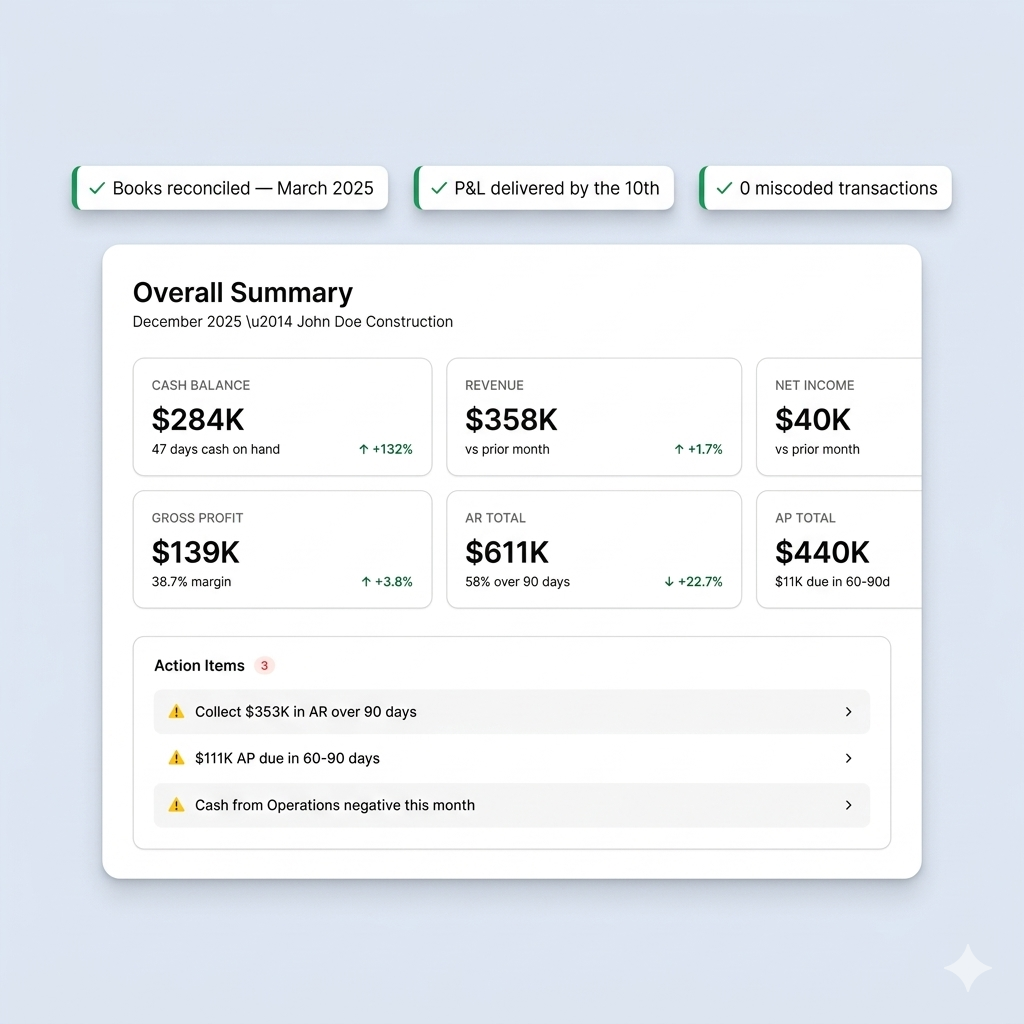
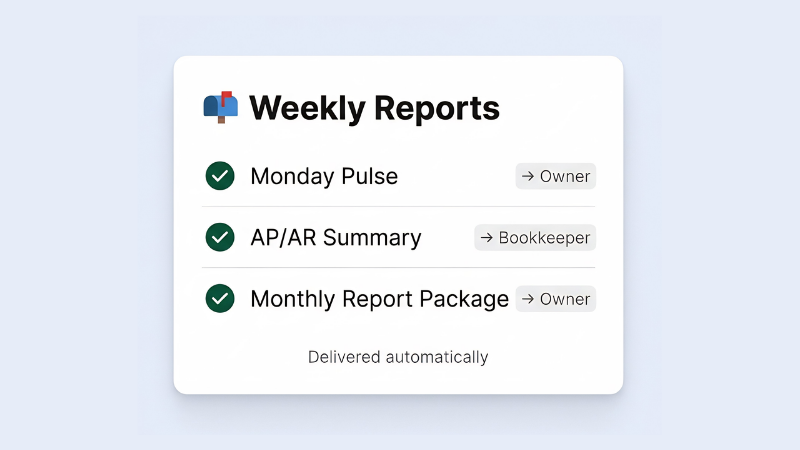
We deliver reporting you can actually use. Monthly P&L, balance sheet, cash flow statement—all on accrual basis. Plus job-level profitability, AR/AP aging, revenue mix breakdown, and a plain-English video explaining what your numbers mean.
We answer questions. When your CPA needs something, we handle it. When your bank wants financials for a loan, they're ready. When you want to know why cash is tight, we can tell you exactly where it went.
Your QuickBooks becomes the system of record. We just run it at a level you never would yourself.
Why Integration Beats Replacement
Some contractors think they need to ditch QuickBooks for industry-specific software. There's a time and place for that—if you're doing $10M+ and need enterprise-level project management, platforms like Aspire or Foundation make sense.
But for most contractors in the $500K to $10M range, QuickBooks Online is the right backbone. Here's why:
Your CPA already knows it. Tax prep is simpler when your accountant works in a platform they use daily. Switching to obscure software creates friction and billable hours.
Banks and bonding companies trust it. When you need financing or a surety bond, they want standard financial statements from a platform they recognize. QuickBooks delivers that.
Integrations actually work. Your CRM, your payroll provider, your payment processor—they all connect to QuickBooks. That ecosystem matters more than any single feature.
It scales. QuickBooks Online Advanced handles multi-entity contractors, custom reporting, and complex job costing. You won't outgrow it before you outgrow needing us.
The issue was never the software. The issue was not having someone who knows how to run it for a contractor.
What You Get Back
When Latch handles your QuickBooks, you get two things: time and clarity.
Time. The hours you spent on bookkeeping—evenings, weekends, random Tuesday afternoons—those come back. You can run jobs, bid work, manage crews, or actually take a day off.
Clarity. You'll know which jobs made money. You'll see cash flow problems before they become crises. You'll have bank-ready financials whenever you need them. You'll understand your overhead, your margins, and your break-even.
That's not just bookkeeping. That's financial visibility at a level most contractors don't get until they're big enough to hire a full-time controller.
The Bottom Line
QuickBooks is the right tool for contractor accounting. It's flexible, widely supported, and capable of everything you need—if it's set up and managed correctly.
The mistake is trying to run it yourself or handing it to someone who doesn't understand construction.
Latch plugs into your QuickBooks, builds it out properly, and operates it for you. You get clean books, job costing, accrual accounting, and monthly reporting without ever logging in.
If you're tired of fighting with QuickBooks—or tired of paying a bookkeeper who doesn't get what you do—there's a better way.
.png)
.png)