The Financial Blind Spots Costing Contractors $50K+ a Year
.png)
The average contractor doing $3M-$10M in revenue is losing somewhere between $50,000 and $150,000 a year to mistakes they don't know are happening.
Not bad bids. Not crew issues. Not marketing waste. Six specific, recurring, mostly invisible financial blind spots — the ones that sit just outside the view of your accountant, your bookkeeper, and your own gut. They're not catastrophic individually. They're a few hundred dollars here, a thousand there. But they compound, quietly, every month, until at year-end you wonder why margin came in lower than it should have.
Here are the six worth knowing about.
1. Duplicate vendor charges nobody catches
The single most common blind spot. And one of the most expensive.
It happens like this: a supplier emails an invoice. It goes to AP. AP pays it. Two weeks later, the same invoice comes through a different channel — maybe the rep sent it directly to the field, maybe it got reissued with a new number, maybe the bookkeeper missed that it was already in the system. AP pays it again.
Nobody notices. The amounts are usually under $5,000 each, which is below most contractors' AP review threshold. The vendor doesn't flag it because the vendor got paid twice — they're not exactly incentivized to call you. Six months later, when somebody finally reconciles a statement, the credit gets buried in a future invoice or just quietly absorbed.
Real example: One contractor caught a $38,000 duplicate payment to a metal supplier in his first week using Latch. He'd paid the same invoice twice, two months apart. He had no idea.
The catch paid for nearly four years of Latch on its own.
Why it stays invisible: Bookkeepers categorize transactions. They don't audit them. Accountants reconcile at month-end against bank statements — but bank statements show that money went out, not that it shouldn't have. The duplicate looks like a normal payment because, mechanically, it is one.
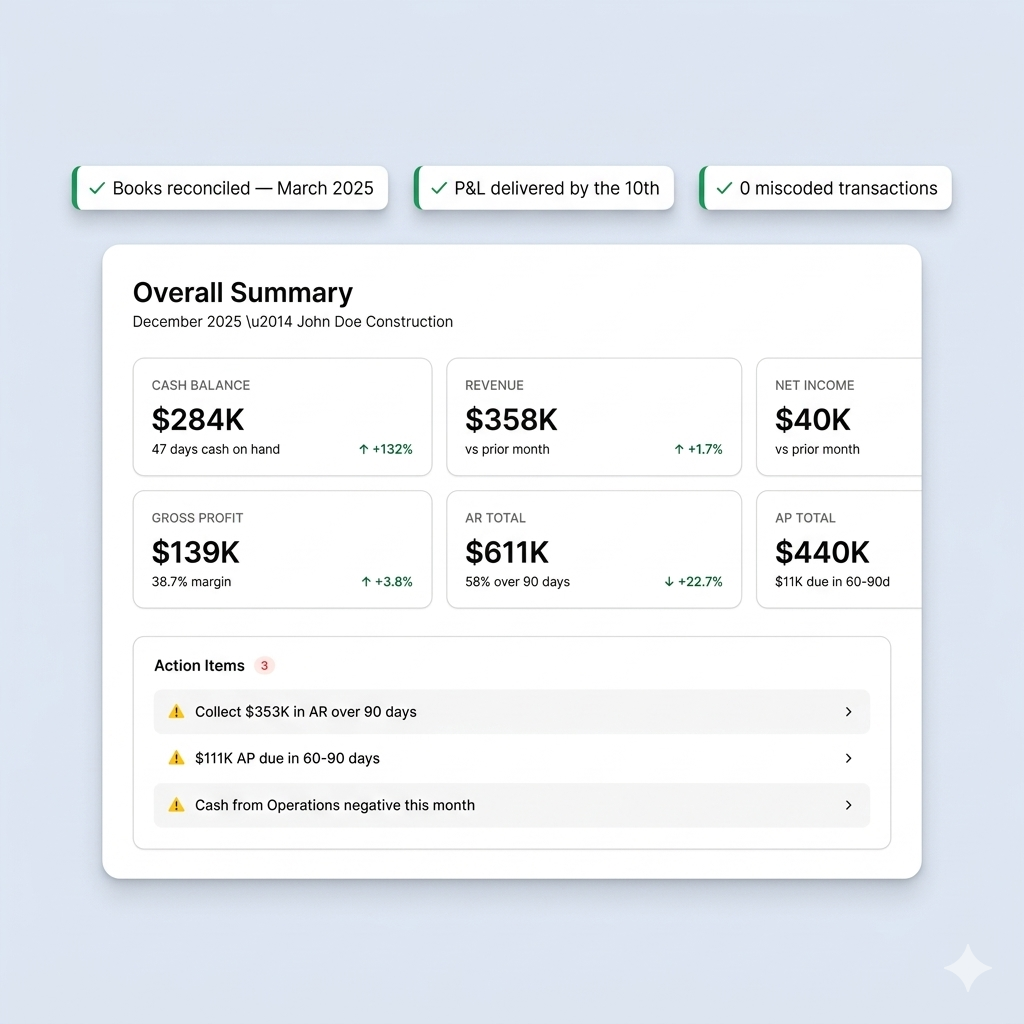
How Latch catches it: Continuous Financial Scan monitors every transaction against vendor history, invoice numbers, amount patterns, and timing. Anomalies fire as alerts within hours, not months. The catch happens before the second check clears.
Estimated annual cost: $5,000-$40,000 depending on AP volume.
2. AR aging past 90 days because nobody's watching
AR is the cash flow killer most contractors underestimate.
Here's the pattern. A job closes. You invoice. The customer pays within 30 days — usually. Sometimes they don't. The invoice ages 45 days, 60 days, 75 days. Nobody at your office is actively chasing it because everyone's busy with current work and the assumption is "they'll pay eventually."
By the time anyone looks closely at the AR aging report, you've got $80,000-$200,000 sitting in the over-90 bucket. That's not money you don't have — that's money you've already earned, sitting in somebody else's account, while you're floating the working capital to keep your business running.
Worse: the longer it ages, the harder it is to collect. AR over 90 days has roughly a 70% collection rate. Over 120 days, it drops to about 50%. Over 180 days, you're at coin-flip odds.
Real example: A roofing contractor doing $7M annually had $312K in AR over 90 days when they started using Latch. Within 90 days of starting prioritized collection workflows — Latch surfacing the top 3 highest-dollar oldest invoices every Monday — they pulled that figure down to $87K. Roughly $225K of cash unlocked. No new revenue. Just collecting what they'd already earned.
Why it stays invisible: AR aging reports exist in QuickBooks. Most contractors don't open them weekly. By the time they do, the problem is already six figures.
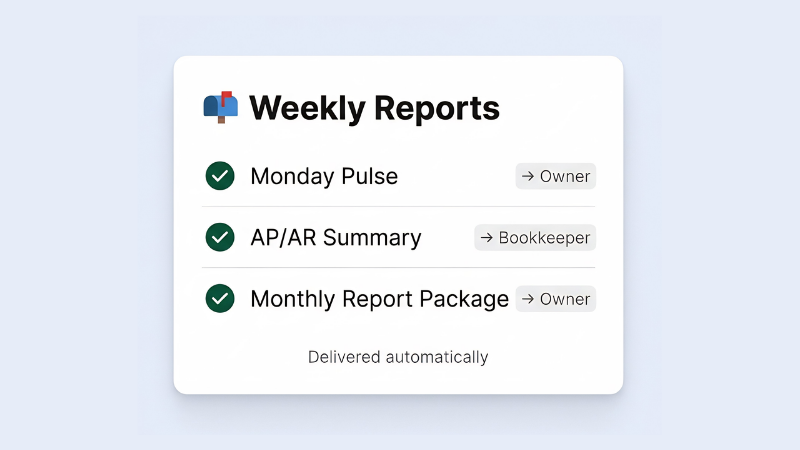
How Latch catches it: AR Intelligence continuously monitors aging buckets and surfaces the highest-risk, highest-dollar accounts. The Monday Pulse includes the top collection priorities every single week. Text "who should I collect from today" and get a prioritized list in seconds.
Estimated annual cost: $15,000-$60,000 in working capital cost, plus 10-30% of aged AR that ultimately gets written off.
3. Jobs that looked profitable but weren't after change orders
This one hurts because it's invisible until well after the job is closed.
You bid a job at a 35% margin. Halfway through, scope grows. You issue a change order — but the change order doesn't get fully repriced. Or it gets approved verbally and never makes it back into the system properly. Or the materials shift but labor estimates don't. Or you eat some out-of-scope work to keep the relationship strong.
The job closes. On paper it looks fine. In reality, your real margin was 22% — not 35%. The difference came out of your pocket, and you didn't even know it.
Multiply that by 20-30 jobs a year, and you're looking at six figures of margin that quietly evaporated without anyone being able to point to where.
Real example: A concrete contractor reviewing his trailing 90 days of completed jobs in Latch found that 7 of his last 14 commercial jobs had real margins 5-12 percentage points below his bid margin — all driven by change orders that weren't fully repriced. Total margin leakage: $73,000 in one quarter.
Why it stays invisible: Bid-to-actual variance reporting requires connecting your CRM data, change order tracking, and final job costing — three systems that don't talk to each other in most contractor stacks. Without an active variance review, you only know the headline margin, not the real one.
How Latch catches it: Job-level P&L pulls real cost and revenue per job from your connected systems and shows bid-to-actual variance on every job. When a job closes below margin target, Latch flags it — and tells you which line items drove the gap.
Estimated annual cost: $40,000-$150,000 depending on job volume and change order frequency.
4. Overhead creeping 2% per quarter without anyone noticing
Overhead doesn't grow in big jumps. It grows quietly.
A new software subscription. A second insurance policy. A small raise here. A vendor that bumped their monthly retainer 8%. A truck lease that got renewed at a higher rate. A field tech that started getting overtime more consistently than the budget assumed.
Individually, none of these moves the needle. Together, over four quarters, they shift your overhead structure 6-10% higher than what your pricing was built around. Which means your break-even moved. Which means jobs that used to be profitable at 32% margin now need to hit 36%+ to actually clear.
Most contractors discover this at year-end when their CPA asks why net income is down despite revenue being up. By then, you've spent an entire year underpricing without knowing it.
Real example: An HVAC contractor reviewing their trailing 12 months in Latch found that operating expenses had grown 11.4% year-over-year while revenue grew 6.8%. Most of the growth was a stack of small increases — none individually flagged, all collectively material. Net effect: 4 percentage points of net margin lost without any single big expense to point to.
Why it stays invisible: Standard monthly P&Ls show overhead as a single line or a few category lines. They don't show the trend. They don't compare to last quarter, last year, or your original assumption. The trend is the story — but nobody's plotting it.
How Latch catches it: Multi-period overhead trend analysis tracks operating expense categories continuously, with breakeven analysis updated as your cost structure shifts. When overhead creep starts affecting your real margin target, Latch tells you — and tells you which categories are driving it.
Estimated annual cost: $25,000-$100,000 in eroded net margin.
5. Paying vendors early when cash is tight
This one's a soft cost, but it's a real one.
Most contractors have decent AP processes. Invoice comes in, gets coded, gets approved, gets paid. Often on the early end of net-30, sometimes even earlier — because it's easier to just pay it and be done than to actively manage the timing.
The problem: when you pay every vendor as soon as the invoice is approved, you give up your strongest cash management lever. A net-30 invoice paid on day 8 is functionally the same as paying cash up front — except you didn't have to. That capital could've been earning float, covering payroll without dipping into your LOC, or simply sitting in your account giving you optionality.
The flip side is worse: when cash actually gets tight, contractors who haven't been strategic about AP timing have nowhere to flex. Every vendor has been paid early, the cash is gone, and now they're scrambling.
Real example: A landscaping contractor with $4.2M in annual COGS was paying vendors on average 11 days into a 30-day window. Latch built a strategic AP schedule that shifted payment timing to days 22-28 (still well within terms, still maintaining vendor relationships). Net effect: roughly $180K of additional working capital available at any given time. Zero damage to vendor relationships. Zero late fees.
Why it stays invisible: AP timing isn't on most P&Ls or cash flow statements. It shows up in working capital efficiency, which most contractors don't measure. The cost is opportunity cost — invisible by definition.
How Latch catches it: AP Intelligence factors in your cash position, payroll calendar, and 13-week forecast to recommend optimal payment timing. Latch literally tells you: "Hold the Patel payment until Friday — Sunbelt is due Wednesday and your payroll funds Thursday."
Estimated annual cost: Variable, but typically $30,000-$200,000 in working capital efficiency for a $5M+ contractor.
6. Vendor price creep nobody renegotiates
Closely related to the duplicate charge problem, but distinct enough to deserve its own listing.
Vendors raise prices. They do it quietly. Sometimes they communicate it ("price increase effective January 1"), sometimes they just start invoicing at the higher rate and trust that nobody compares line items across months. Material costs especially are subject to this — concrete, lumber, asphalt, copper, steel all move with commodity prices, and many suppliers tack on 3-5% above commodity moves as margin protection.
What contractors typically do is nothing. They notice prices feel higher. They mutter about it. They keep buying from the same vendor because switching is painful. Then they wonder why their material cost percentage drifted up 4 points over a year.
Real example: A roofing contractor running quarterly spend reports in Latch found that one of their primary suppliers had raised prices 11.3% over a six-month window — never communicated, just gradually rolled into invoices. A 30-minute conversation with a competing supplier resulted in a quote $3,400/month lower on equivalent volume. Annualized: $40,800 in margin recovered with one phone call.
Why it stays invisible: Most contractors look at total spend per vendor, not unit price drift. The total spend going up looks like volume growth. Unit price drift requires comparing line items across months — work that nobody has time to do manually.
How Latch catches it: Spend Reports break vendor spend down by category and detect unit price drift across periods. When a vendor's prices creep beyond a threshold, Latch flags it with the dollar impact and recommends action — including specific suggestions like "get a competing quote from [Vendor X], market rates suggest savings of $X."
Estimated annual cost: $20,000-$80,000 in eroded gross margin.
What it all adds up to
Take the midpoint of every estimate above and you're looking at roughly $135,000 a year in money quietly leaving the business — for a contractor doing $5M in revenue.
That's not a number that shows up on any report. There's no line item called "money you didn't catch." It shows up as margin slipping a few points. Cash being tighter than it should be. The vague sense that the business is harder to run than it used to be.
Most contractors never find this money because nobody is looking for it. The accountant isn't looking — that's not their job. The bookkeeper isn't looking — that's not their job either. The owner can't possibly look across all six categories continuously while also actually running the business.
That's the gap Latch fills.
The point isn't software — it's the work it does
Every one of the six blind spots above has the same structural problem: it requires continuous attention across systems that don't talk to each other. QuickBooks doesn't know what your CRM knows.
Your CRM doesn't know what your bank knows. Your bank doesn't know what your accountant knows. The information needed to catch any of these blind spots lives in pieces, scattered, and reconciling those pieces in real time is more work than any human can sustainably do.
Latch connects all of it, monitors continuously, and texts you when something's worth your attention. That's not a feature list — that's the entire job.
For most contractors, finding one of these blind spots in the first 30 days pays for Latch for the next several years.
See what you're missing
Latch is free to try for 14 days. Connect QuickBooks, your bank, and your CRM in about ten minutes. Within the first week, Latch will surface what's actually happening across these six categories in your business.
If we don't find at least one blind spot that pays for Latch within the first month, we'll give you two more months free.
Try Latch at golatch.com.
The money is already leaving. The question is whether you see it leave.
.png)