Why Your Accountant Can't Tell You What Latch Can
.svg)
The 30-day-old P&L problem
Here's what most contractors get from their accountant: a Profit & Loss statement, delivered between the 10th and the 30th of the following month, summarizing what happened 30 to 60 days ago.
You open it. You see margin slipped. You think "huh, that's not great." And then you go back to running the business.
The problem isn't the P&L. The problem is that by the time you see it, the decisions that caused those numbers are already two months behind you. You can't unwind the bid you took in October. You can't re-time the payments you made in November. You can't unfire the crew you let go in December because cash got tight.
Last month's P&L tells you what already happened. It doesn't help you decide what to do tomorrow.
That's not a knock on accountants. That's the job description. Accounting is historical by design — it's a recording function, not a decision function. The work is rigorous, regulated, and necessary. It's just not the same job as running the finances.
The bookkeeper gap
Your bookkeeper sits closer to the action. They're in QuickBooks every week — categorizing transactions, reconciling bank feeds, cleaning up vendor entries, making sure the books are right.
That's important work. If your books are wrong, everything downstream is wrong.
But here's what your bookkeeper isn't going to do:
- Text you at 6:47 AM to say cash dipped below your payroll coverage threshold
- Notice that your concrete vendor quietly raised prices 11% over three months
- Catch that you paid the same Henderson invoice twice in two months
- Build a 13-week cash forecast and update it every Sunday night
- Tell you which of your last 14 jobs lost money after change orders
- Flag that your Google LSA campaign is returning $8.40 per dollar while Facebook is returning $0.90
Not because they're bad at their job. Because none of that is their job. A bookkeeper categorizes transactions. They don't interpret them. They don't recommend actions. They don't sit on your shoulder telling you which decisions cost you money and which ones made you money.
That work — the interpretation, the recommendation, the proactive flagging — is CFO work. And most contractors under $50M don't have a CFO.
Why fractional CFOs only half-fix it
The traditional answer is to hire a fractional CFO. $3,000 to $8,000 a month. Two calls a month. They review your numbers, give you opinions, and disappear until next time.
That's a step up from your accountant — at least someone is thinking about the business. But it has three structural problems.
Generic reporting. Most fractional CFOs serve 15-25 clients. They don't have time to deeply learn your specific job mix, your vendor relationships, your crew utilization patterns. You get templated insights — the same dashboards every contractor in their book gets, with your numbers plugged in.
Two-hour windows. They're available when their calendar says they're available. The decision you need to make Wednesday at 3 PM doesn't wait for your scheduled Thursday call.
The cost ceiling. $5,000 a month is $60,000 a year. For most contractors doing $1M-$10M, that's not realistic. So they go without — which means they go without CFO-level thinking entirely.
A fractional CFO is a real step up. But it's still a part-time hire trying to do a full-time job, sold at a price point that excludes most of the businesses that need it most.
A week in the life of a Latch user
Here's what's different. This is a real week for a roofing contractor on Pro — names changed, numbers real.
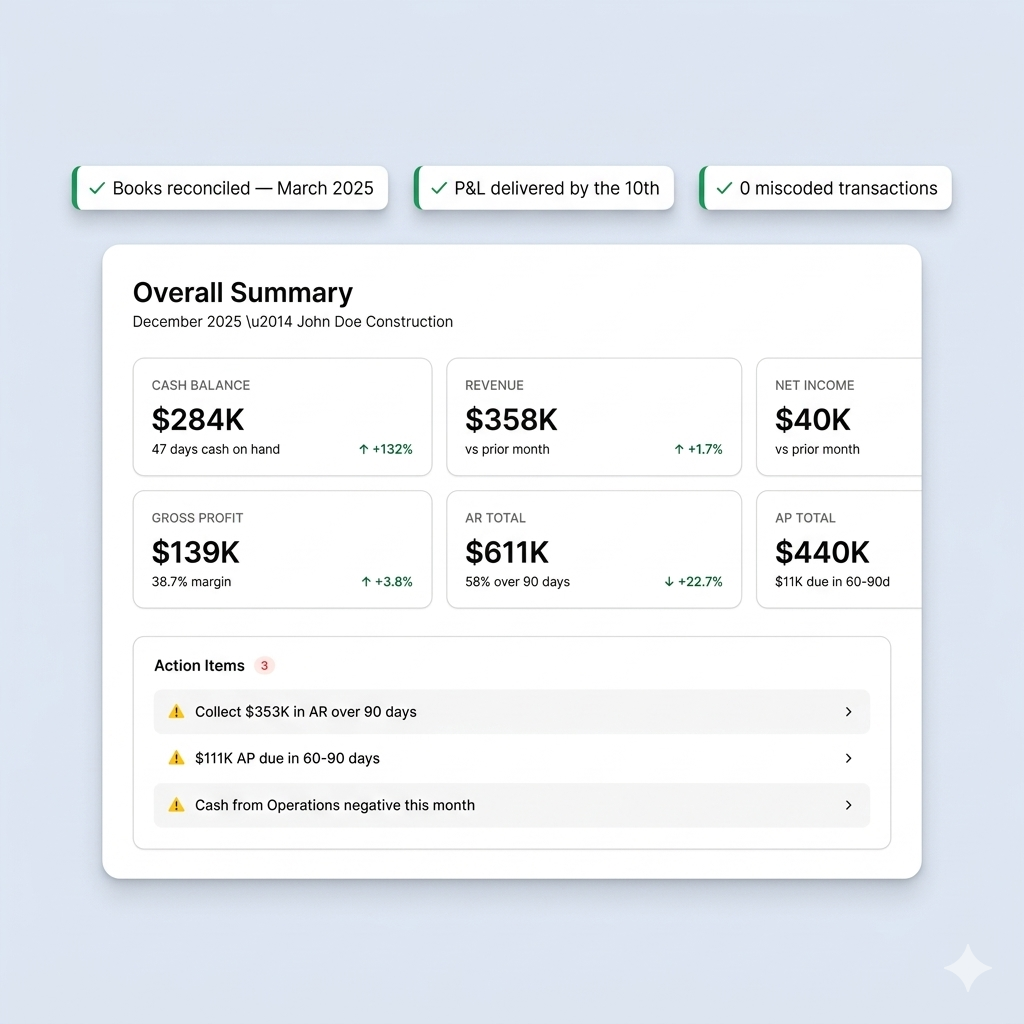
Monday, 9:00 AM. Latch sends the Monday Pulse. One text, top-to-bottom summary of the prior week: Cash position $147K, down $23K week-over-week. AR over 90 days: $84K — Henderson and Patel are the two big ones. Gross margin on completed jobs last week: 38.4%, right on target. Three jobs at risk of slipping below margin if material costs hold. One vendor flagged for review.
He reads it in 90 seconds while drinking coffee. Knows exactly where the week stands before his crew foreman calls.
Tuesday, 6:47 AM. Alert fires. "Heads up — duplicate charge from Sunbelt Supply detected. Same invoice number, $4,820, posted twice in the last 11 days. Holding the second one in suspense. Want me to flag it to Karen and request a credit?" He texts back "yes." Karen gets a draft email from him within the hour. By Friday the credit is processed.
That single catch covered most of a year of Latch by itself.
Wednesday, 11:12 AM. He's mid-quote on a Henderson commercial roof. Texts Latch: "what's my real margin on commercial jobs over $50K the last 6 months." Eight seconds later: "Average gross margin on commercial jobs over $50K (last 6 months, 9 jobs): 33.7%. Two of those slipped below your 35% target — both driven by change orders that weren't repriced. Recommend a 4% buffer on this quote, especially if scope can grow."
He builds the buffer into the quote. Wins the job. Has a real shot at his target margin on it.
Thursday, 2:30 PM. Texts Latch: "who should I collect from today." Four seconds later, a prioritized list: "Top 3 by dollar value at risk: Henderson ($28K, 94 days), Patel ($19K, 78 days), McAllister ($12K, 67 days). Henderson is your biggest exposure — last contact was 23 days ago. Want me to draft the email to their AP team?"
He says yes. Email goes out at 2:34 PM. Henderson pays Tuesday.
Friday, 4:45 PM. Closing out the week. He didn't open QuickBooks once. Didn't build a single spreadsheet. Didn't wait for a single report. The financial leadership work — the part that used to require a $5,000/month CFO or, more often, just not get done — happened automatically, in his text thread, while he was running the business.
That's the difference. That's the whole pitch.
The old way vs. the Latch way
To make this concrete, here's the side-by-side.
DecisionOld wayLatch wayKnowing if a job is profitableWait for month-end close, dig through QuickBooksText Latch, get gross margin on that specific job in 6 secondsCatching a duplicate vendor chargeCatch it 4-6 months later during audit (if at all)Alert fires within hours of the second charge postingKnowing if you can make payrollCheck your bank account on Wednesday and hopeLatch flags payroll coverage risk 5+ days in advanceForecasting cash positionBuild a spreadsheet, hate it, abandon it13-week forecast updates continuously, alerts when it driftsKnowing which marketing channel is profitableLook at lead volume, guess based on gutCost per lead and ROI by channel — texted on requestReviewing prior month performanceWait 30 days for accountant's P&LMonday Pulse every week at 9 AM with full pictureAsking a finance question at 9 PMWait until tomorrow. Or next Thursday's CFO call.Text Latch. Get a real answer in seconds.
The old way isn't broken because the people doing it are bad at their jobs. It's broken because the cadence doesn't match how a business actually runs. Decisions happen continuously. Reporting happens monthly. There's always going to be a gap there — until you fill it with something that runs continuously too.
That's what Latch is.
The ROI math
Most of this conversation comes down to one question: what does it cost, and what does it save?
The cost side is easy. Latch Starter is $299/month. Pro is $499/month. Pro+ adds a dedicated human controller for clients who want both the AI and a human in the loop.
The savings side is where it gets interesting. Here's a conservative breakdown of what Latch typically returns in the first 90 days for a contractor doing $3M-$10M in revenue.
One caught duplicate or miscoded payment. Average we've seen: $2,400-$38,000. Even a small one pays for the entire year.
Margin recovered through job-level visibility. Pulling 1-2 percentage points back on annual revenue. On a $5M business, that's $50,000-$100,000 a year.
Vendor creep caught and renegotiated. Most contractors find at least one vendor where prices have crept 8-15% without notice. Catching it and renegotiating typically saves $2,000-$5,000/month.
Faster collections. Pulling AR days down from 65 to 45 doesn't sound dramatic until you do the math. On a $5M business, that's roughly $275K of cash unlocked.
The hours back. Most owners spend 4-8 hours a week on financial admin — chasing reports, building spreadsheets, hunting down numbers. Latch eliminates most of that. At an effective rate of $150/hour, that's $30,000-$60,000 a year in time alone.
Compared to a $3,000-$8,000/month fractional CFO who gives you templated dashboards twice a month — or doing it yourself, which is what most contractors actually do — the math isn't close.
What Latch isn't
Worth being clear on what we don't do, so the comparison is honest.
Latch doesn't replace your bookkeeper. We don't do data entry, file your taxes, run your payroll, or pay your bills. Those jobs still belong to the people who do them well today.
What Latch replaces is the gap. The space between "the books are clean" and "I know exactly what to do this week." That gap is where most contractors lose money — slowly, invisibly, month after month — and it's the gap a real CFO is hired to close.
We just made the CFO part not require a $200K hire.
See it work
Latch is free to try for 14 days. No credit card to start. Most contractors are connected in under ten minutes.
If it doesn't pay for itself in the first month — through caught mistakes, recovered margin, or smarter cash decisions — we'll give you two more months free. We haven't had to honor it yet.
Try Latch at golatch.com.
Your accountant tells you what already happened. Latch tells you what to do next.
.png)
.png)